
A twelve-item repair list can hold one problem that needs attention today and several that can wait for the next service visit. Sort it by consequence, ahead of quote size or how bad something looks, and the captain gets a work plan they can defend while the owner gets a clear decision to approve.
A four-level severity scale
Rate the condition you found, not just the component. The same piece of equipment can produce a low-severity finding one month and a critical one the next.
Critical
An immediate threat to people or the boat. Uncontrolled water coming in, or an electrical fault that’s actively heating, belongs here. Follow the boat’s emergency procedures straight away, without waiting for routine repair approval. Protect people and stabilize the situation first, and sort out the paperwork after.
High
A defect that could disable an essential system or cause further damage. Set a prompt repair deadline, and any operating restrictions until it’s fixed.
Blocked doors, stairways and access routes are high severity. Clear them immediately. How much a repair costs, or how complicated it is, says little about what happens if you leave it.
Medium
A contained defect with limited consequences, where essential systems still work. Schedule it into a set work window, once you’ve checked that using the boat in the meantime is safe and won’t turn a small repair into a bigger one.
Low
A cosmetic defect with no known effect on safety or operation. Minor finish damage fits here once you’ve ruled out anything underneath it. Give it a real place in the work plan so it doesn’t drift into an open-ended “later.”
Twelve findings after a walkthrough
Here’s a hypothetical list from a walkthrough that included equipment checks. Each rating applies to the condition as described, and it can change as the condition develops.
| # | Finding | Severity |
|---|---|---|
| 1 | Rising bilge water traced to a leaking seawater fitting | Critical |
| 2 | Fresh seepage around a generator raw water strainer lid | High |
| 3 | Bilge pump fails its check, backup pump works | High |
| 4 | Stored gear blocking engine room access | High |
| 5 | Engine coolant hose cracked and damp | High |
| 6 | Freshwater faucet dripping into the sink | Medium |
| 7 | Deck washdown pump failed, circuit safely isolated | Medium |
| 8 | Cockpit seat stitching opening up | Medium |
| 9 | Guest head sink draining slowly, no leak | Medium |
| 10 | Small scuff on the topside paint | Low |
| 11 | Minor scratch on cabin joinery | Low |
| 12 | Faded cockpit cushion fabric | Low |
The failed bilge pump becomes critical if the remaining pumps can’t keep up with the water coming in. A severity rating is a judgment about the boat as it is today, and it should change when the conditions do.
Keep the finding attached to the work
When the priority list lives in a spreadsheet and the evidence lives in a group text, the technician’s first questions are which strainer and what changed.
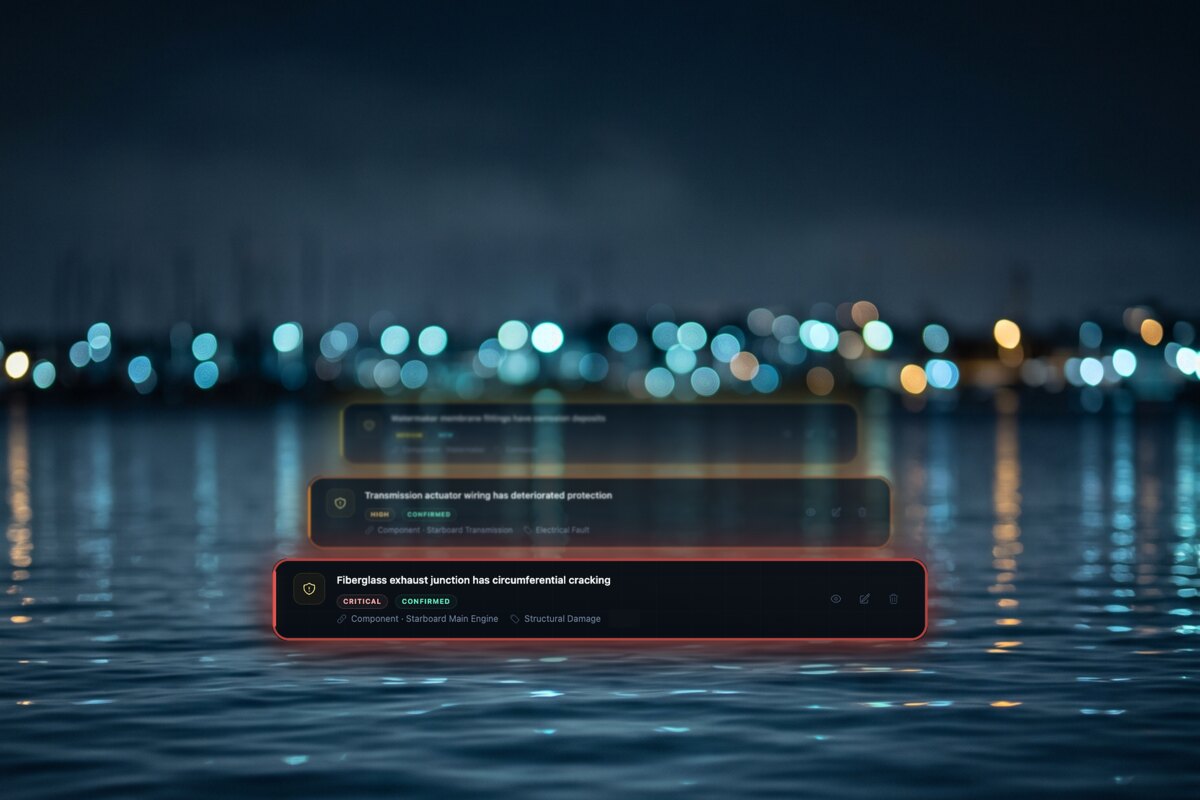
Harbor Guardian brings everything flagged during inspections and checklists into one review queue. You confirm, dismiss or route each item. A confirmed finding keeps its severity, status, photos and location aboard, and you can turn it into a task or work order in one step.
For the weeping strainer, the work order stays linked to the finding and the component, with the vendor and the paperwork attached. The job moves through completed to verified, so the original seepage and the documented repair stay connected.
Decide what waits, and until when
Severity tells you the risk. Your plans for the boat help set the deadline. A generator cooling fault matters before a trip that depends on that generator. A washdown pump that’s safely isolated can wait for the next service visit.
Write down why each item is waiting, and what change would mean taking another look. If the seepage gets worse, for example, it needs a fresh decision without waiting for the original due date.
Give every medium and low finding an owner and a review date, even while approval is pending. Group jobs that fit together into one planned visit, such as upholstery repairs during the next yard period. Go through the open findings before that visit’s scope is set, so the small jobs make it onto the work order.
Explain the priorities to the owner
With each approval request, give the owner the consequence of waiting and the proposed scope, with a current photo and an estimate where you have them.
For the strainer, explain that fresh seepage needs inspecting and repairing before anyone relies on the generator. The topside scuff can join the next planned finish work. Separating essential repairs from optional appearance work shows the owner what the budget protects and makes every deferral a deliberate choice. They end up approving a clear work plan instead of puzzling over a list of defects.
Put every finding where it can’t get lost
A severity scale only works if every finding is recorded, rated and followed through to a verified repair. Harbor Guardian keeps the queue, the evidence and the work in one place, so nothing on the list quietly turns into next year’s emergency.
Contact us and we’ll show you how findings and repair work would stay connected on your boat or across your fleet.